A Calm Routine for Following a Story That Is Still Developing
A calm routine for following a developing story helps you separate useful updates from repetition and keep a clear record of what remains unresolved.
The most common mistake with a developing story is letting a stream of alerts set your pace. The cost is attention spent on repeated fragments, while the question that matters to you stays unanswered. A calm routine for following a developing story starts with a purpose: decide what you need to know, then check only when new information could change your understanding or next action.
A traveller checking a disrupted route needs a different approach from someone keeping an eye on a public inquiry. You do not need to follow every part of a story to understand the part that matters. A short record and a deliberate checking rhythm can help you stay oriented without keeping the story open all day.
Choose your purpose
Begin with the decision or question behind your interest. It might be whether to take a different route, what a new policy means for your household, or how an inquiry is progressing. That purpose determines which sources are relevant and when another check is useful.
- Immediate plans: If a transport disruption or local service notice could change where you go, check the responsible organisation and a reliable news outlet. If their latest information changes your plan, act on the updated information; otherwise, continue with your existing plan and check again only if a credible change is announced.
- A consequential event: If you are following an election count, court decision or public emergency, identify the specific outcome you need to understand. If a new report bears on that outcome, compare it with your previous understanding; if it does not, set it aside rather than tracking every detail.
- A long-running story: If you are following an inquiry or investigation without an immediate decision to make, choose a quiet interval or a named milestone. If a scheduled development arrives, check then; if nothing is due, wait rather than refreshing repeatedly.
- General orientation: If your aim is simply to understand a story, read a clear explainer or recent account and note one unanswered question. If later reporting answers or materially changes that question, return; if not, leave the story until there is a reason to revisit it.
If a story concerns an immediate safety risk, follow instructions from the relevant local authority or emergency service. News coverage can add context, but it is not a substitute for direct guidance or qualified professional advice where that applies.
Keep a short log
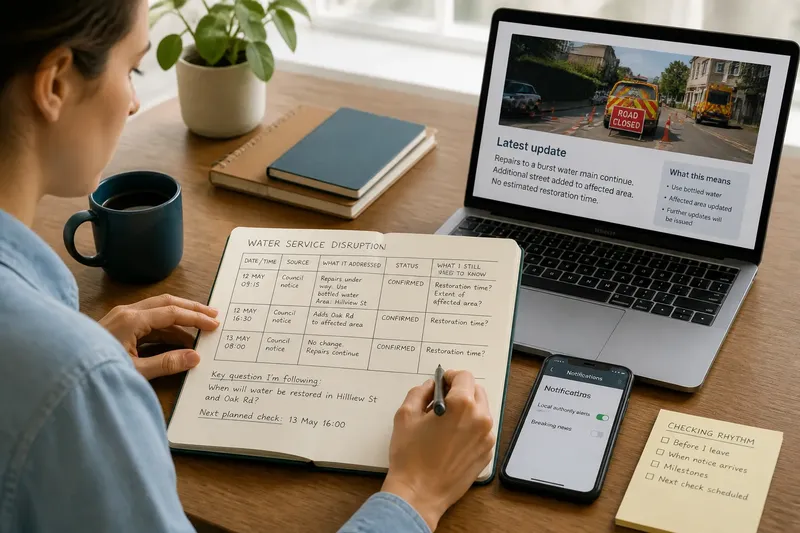
A useful log is easy to update. In a notebook, document or notes app, record when you checked, which source you used, the point it addressed and what you still need to know. Keep entries distinct so that a later development does not blur what you understood earlier.
Say you are following a hypothetical water-service disruption in your neighbourhood. At the starting point, a council notice says repairs are under way and advises one area to use bottled water; it gives no restoration time. You enter the notice and its time, record the affected area and leave the timing unknown. At your next planned check, a new council notice adds another street to the affected area but gives no timing. You add the street, keep the timing question open and consult the council notice before making a decision about water use. The resulting record makes clear what the council has advised and what it has not yet established.
A paper log is like a kitchen noticeboard: an older note can stay visible beside the latest one, while a clear mark shows which instruction has been superseded. In a digital note, use dated entries and label outdated points rather than deleting them. That gives you a record of how the account changed without presenting old information as current.
Label the claim
Use labels that describe the status of a specific claim. “Confirmed” should refer to a point established by a source with direct knowledge, a relevant record or clearly described evidence. “Reported” means an outlet has published the claim; “unconfirmed” means the information available has not settled it; “disputed” indicates that sources or involved parties give conflicting accounts.
Keep the wording as narrow as the source. If a police service confirms an arrest, that does not establish motive, the full sequence of events or guilt. If a company says a service has resumed, that does not establish that every customer can use it. A note such as “the agency says the road is closed” is more precise than “the road is unsafe”.
Separate evidence from interpretation, too. A document may show that a decision was issued, while an expert explains possible effects and a commentator argues for a broader meaning. Those are different contributions. Keeping them in separate notes helps prevent an interpretation from quietly turning into a reported fact.
Decide what changed
When you return to a story, ask a focused question: does this information change the point I am following? A useful update might add a directly relevant fact, alter the known scope of an event, or clarify a question that was previously open. An article that repeats familiar background may be informative, but it need not change your log.
Keep a new detail distinct from a changed account. A witness statement may add perspective without changing what an authority has confirmed. A later announcement may revise a location or clarify which people are affected. Record the difference in plain language; avoid blending earlier and later descriptions into a single account that conceals what remains uncertain.
For practical decisions, identify the source that can answer the question you actually have. If you are considering a journey, a transport operator’s current service notice may be more useful than a broad discussion of the disruption. If you are following a policy announcement, the published document may clarify what changed while reporting explains its context.
Set a checking rhythm
Match your routine to the story and your purpose. For a disruption that could affect a journey, check before you leave and again if a relevant notice arrives. For a slower inquiry, return at a chosen time or when a named milestone is due. If you have no decision to make and no expected development, waiting is a sensible choice.
Keep alerts that help you act or follow a specific question, and mute those that only interrupt. You might retain local authority notifications for a local disruption while switching off general breaking-news alerts for a longer-running national story. The aim is to make notifications useful for your chosen purpose, not to judge which stories deserve attention.
At each check, compare the new information with your log. If the answer to your question has not changed, close the note and return to your day. Repeated refreshing can add fragments without making the account clearer.
When should you check again?
What makes an update useful?
An update is useful when it bears on your question or could affect a decision. If it only repeats background, leave your log unchanged; if it adds a relevant fact or changes the known scope, record that specific difference.
How often should you check?
Check when a current decision depends on the information, a relevant source has announced an update, or a development could change your understanding. For slower stories, choose a quieter rhythm that suits their pace rather than responding to every notification.
What if accounts conflict?
Record both accounts, name their sources and state exactly where they differ. If a document, direct statement or later report resolves the disagreement, update the note; until then, leave the point open rather than choosing the more complete-sounding version.
When can you pause?
Pause when you have no current decision to make and no specific question that a new check could answer. If a named milestone or relevant notice arrives later, return then instead of keeping the story in your attention all day.
Leave a clear marker
Before you stop, write a brief note stating what is established, what changed during this check and what remains open. If the story affects a practical choice, add the source you would consult before acting. That marker lets you resume without retracing every alert or mistaking an old detail for the current account.
A calm routine for following a developing story is not a contest to collect the most updates. It is a way to keep the question, source and claim in view. Once you have written down what would make you check again, you can let the story wait until that point arrives.