From the Front Page to the Push Alert: How News Formats Changed the Day
See how newspaper pages, broadcast bulletins, websites and phone alerts changed when news arrives and how much context each format can carry.
The most common mistake is to treat a phone alert as a smaller newspaper headline: it costs readers the context that helps them understand what has happened. News formats have always shaped not only how a story looks, but when it reaches people and how much of it they can take in at once.
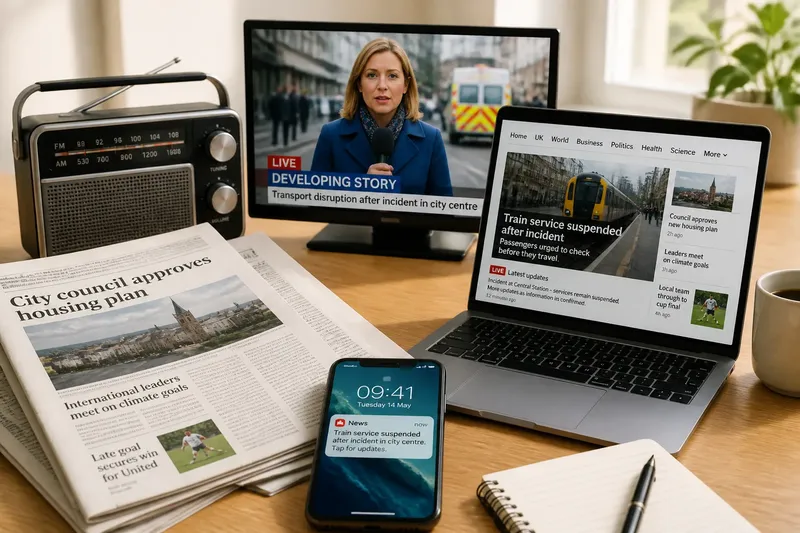
From the front page to the push alert, each change brought a new rhythm. A printed edition gathered stories into a daily package; radio and television brought scheduled voices and pictures into the home; websites made updates easier to publish; phones made brief notices immediate and portable.
What did the front page do?
A newspaper front page offered a visible map of the day's news. Editors arranged stories by position and size, while headlines, photographs and captions helped readers decide where to begin. The page could place a local council decision beside an international event, making the contrast part of the reading experience.
Print also imposed a useful boundary: the edition was assembled, printed and delivered as a package. A story could be expanded across inside pages, but readers generally encountered it in the form prepared for that edition. The next edition created a natural moment for new developments and revised emphasis.
That arrangement encouraged browsing. Someone who bought a paper for the sport might notice a prominent housing story on the way to the back pages. The front page was therefore both a selection of important stories and an invitation to move through the rest of the paper.
Why did bulletins change the rhythm?
Radio news made the voice and the clock central. A bulletin could bring a set of reports to listeners at a scheduled time, with a presenter guiding them from one item to the next. Rather than scanning a page, people listened in sequence, often while doing something else.
Television added images, recorded scenes and the presence of a presenter. A report could show a street, a press conference or a map as well as describe it. Those elements made events feel immediate, but the bulletin still had a running order and a set time: one report gave way to the next.
Broadcast formats also made repetition familiar. A listener or viewer could catch the next bulletin if they missed one, while breaking coverage might interrupt the usual schedule. The story’s timing was now tied not only to an edition but to programme slots and live transmission.
What changed with news websites?
Websites loosened the link between a story and a single edition or bulletin. A report could be published as developments arrived, with links to background material and related coverage. Readers could enter through a search result or shared link rather than starting at a publication’s front page.
This changed the shape of the page, too. A website could combine text, photographs, video, maps and links, but readers did not always see the same sequence. One person might open the main report; another might arrive at a related explainer. The publication’s homepage still provided an editorial selection, but it no longer controlled every route into a story.
Updates also altered the feel of a report. A developing page might accumulate new information while older paragraphs remained below. Clear timestamps and wording can help readers tell whether they are seeing a fresh development or background carried over from earlier coverage.
Why are phone alerts so brief?
A phone alert has little room and competes with messages, calendar reminders and other interruptions. Its job is usually to signal that something has happened and give enough detail for a reader to decide whether to open the full report. It cannot comfortably carry all the qualifications, context and evidence that a longer article can hold.
That makes the alert a doorway, not a complete account. A compact message may identify the event and its immediate significance, while the linked story can explain what is known, what remains uncertain and why the news matters. Readers should be wary of treating the notification as the whole report, especially when its wording is necessarily compressed.
Say you receive an alert that a local train service has been suspended after an incident. The message may name the route and point to an update; opening it could reveal which stations are affected, what alternative travel is available and whether the cause has been confirmed. The useful result is not simply more detail, but a clearer sense of what the notice does and does not tell you.
How should you read each format?
Match your expectations to the format. A printed page offers a selected collection and the pleasure of browsing; a broadcast bulletin offers a timed sequence; a website can provide depth and ongoing additions; an alert is a brief prompt to pay attention. None carries every function equally well.
For a significant story, move from the short format to the fuller account when you need context. Check the publication and the time attached to the report, then look for what is confirmed, what is attributed to a source and what remains unresolved. If you are listening or watching, notice whether the segment is a live report, a recorded package or a brief headline; those forms offer different amounts of explanation.
Think of formats as containers with different openings: a newspaper page is like a tray with several things laid out, while an alert is more like a note slipped under the door. The note can point you towards something urgent, but it is not a substitute for looking at what lies beyond it.
What questions do readers ask?
Why do alerts leave out context?
Phone notifications have to communicate quickly in a small space, so they usually prioritise the event and a reason to open the story. The linked report is where readers can look for explanation, qualifications and developments.
Are websites always more up to date than newspapers?
Websites can be updated between print editions, but a page may not change simply because it is online. Check its timestamp and the wording of the report rather than assuming that the digital format means the information is current.
Why do broadcast reports repeat the same details?
Radio and television audiences may join at different moments, so a presenter can restate the basic facts to make a segment understandable on its own. Repetition can also mark which points remain central as a story develops.
Which format gives the fullest account?
A substantial written report often has room for more detail and links, while audio or video can convey voices, scenes and tone. The fuller choice depends on the story and what you need to understand; several formats may complement one another.
How has the news day changed?
The shift from front pages to alerts did not simply make news faster. It separated the moment a reader first hears about an event from the moment they make time to understand it. A daily paper bundled discovery and reading together; a notification can interrupt any part of the day and leave the reader to choose whether to follow the link.
That is why the format still matters after the first headline. If a phone alert catches your eye, treat it as a pointer and open the report when the story merits attention. For news formats, the most useful habit is to ask what this particular form can tell you—and what you need to read or hear next.