How to Read a News Headline Without Overreading It
Learn how to read a news headline without overreading it: match its wording to the article’s evidence, scope and certainty before repeating the claim.
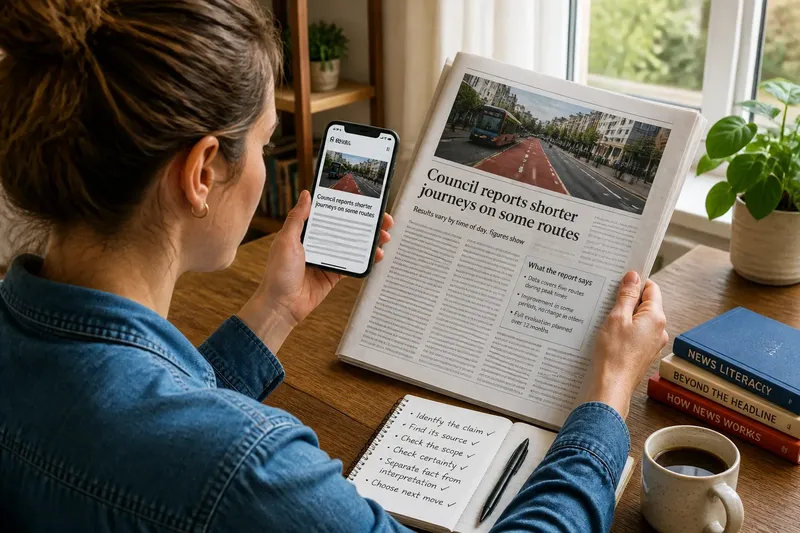
The most common headline mistake is treating a vivid line as a complete account. When you read a news headline without overreading it, you avoid turning a limited claim into a broader one than the article supports.
Headlines have little room to name every condition, source or uncertainty. Their wording can still be useful: it points you towards the story’s central development. The trouble starts when a compressed phrase is repeated as though it carries all the detail in the article.
Headlines and limits
A headline must identify a story in a small space, often among other headlines on a phone screen. The article can explain who is involved, what evidence supports the claim and what remains uncertain. Those details may change how a reader should understand the headline.
For instance, “Council considers closing library” signals a proposal, but does not say which committee discussed it, what alternatives are on the table or whether a decision is close. The article has room to make those distinctions; the headline is a signpost, not the whole account.
Think of a headline as the label on a folder. It helps you find the right material, but the label cannot tell you every condition recorded inside. Ask what exact claim the headline makes, then check how the article defines and supports it.
Three reading approaches
The quick scan
Read the headline and opening paragraphs to identify the subject, main actor and immediate development. This is useful when you are deciding whether a story is relevant enough to open.
A scan may not reach the important qualification. If a policy is only proposed, or applies to a particular service, that detail may appear later. Treat a scan as a way to sort stories, not as a basis for repeating a consequential claim.
The claim-focused check
If one assertion is what you want to discuss or share, locate it in the article and look for its support. Note whether the article attributes it to an official, a document, an expert assessment or another source.
Pay attention to boundaries such as “may”, “according to officials” and “in the areas reviewed”. If the text describes a possibility, do not retell it as a certainty. If the claim applies to selected places or people, keep that scope intact.
The full-context read
Read beyond the lead when the issue is consequential, contested or difficult to explain fairly. Follow how the article connects its claim to supporting material, qualifications and relevant responses.
Reading the whole piece does not mean accepting every sentence without question. It gives you a clearer view of what each source can establish—and what it cannot. A quoted organisation may explain its own position, for example, but that position is not automatically independent confirmation.
Checking a headline claim
Use these checks when a headline’s wording matters to what you plan to say or do:
- Identify the claim: If the headline names a person, event or result, restate that claim plainly; if you cannot tell what it asserts, read the opening paragraphs before drawing a conclusion.
- Find its source: If the article names a document, official or other source for the claim, note who is speaking; if it does not explain the source, keep your conclusion narrow and seek the underlying material when the issue matters.
- Check the scope: If the evidence covers a particular place, group or set of conditions, retain those limits; if the headline sounds broader, do not repeat it as applying everywhere.
- Check certainty: If the article uses words such as “may” or “could”, preserve that uncertainty; if it describes a confirmed event, state only what the text establishes.
- Separate report from interpretation: If a source offers an opinion about what an event means, attribute that view; if the article reports an event directly, do not add a cause that it has not established.
- Choose your next move: If you only need to decide whether a story is relevant, a scan may be enough; if you plan to share or act on its claim, read the relevant context before doing so.
Say you see a headline claiming that a town’s new bus lane “cuts journey times”. Imagine the article attributes that claim to a council account of selected routes and says results vary by time of day. You restate the claim as “the council reports shorter journeys on some routes”, then retain the time-of-day qualification. Your resulting account is narrower than the headline, but it does not imply that every passenger’s trip is quicker.
Choosing how deeply to read
Let your purpose set the amount of attention. A quick scan can help you sort stories by relevance. A claim-focused check suits a statement you plan to remember, discuss or share. A full-context read is more useful when you need to explain a complicated or disputed account.
Imagine a parent sees a headline about a school timetable change. The parent first scans the opening to decide whether the story concerns their area. The article says the change is under discussion, so they check which schools and dates are mentioned before telling other families. Their resulting message describes a proposal rather than a settled change; that is the trade-off between a quick impression and a reliable account.
Questions about headlines?
Can a headline be accurate but incomplete?
Yes. It may capture the central development while leaving a limitation for the article to explain. The relevant question is whether the headline gives a materially different impression from the fuller account.
Should I read beyond the opening?
Read further if the claim could affect a decision or if you plan to pass it on. Qualifications, responses and distinctions may appear after the lead.
What if the article does not support its headline?
Do not repeat the headline as settled fact if the article does not explain its claim. Keep your conclusion narrow, and look for an underlying document or another account if the issue matters.
Why do headlines use vivid wording?
Vivid wording can make a story’s central point easy to recognise, but it may also make a limited claim sound broader. Check whether the article supports the strength and scope of the language before adopting it.
Reading headlines carefully
To read a news headline without overreading it, match your retelling to the article’s evidence and limits. “The proposal could change bus routes” does not mean “the routes are changing”; a source’s interpretation is not the same as an established cause.
When you share a story, carry its most important qualification into your own words. A brief phrase such as “officials say” or “in the areas reviewed” can show exactly where the claim begins and ends, helping the next reader judge it fairly.